Overview
Equality in human dignity is a fundamental right that everyone deserves. Every person should have the chance to live a fulfilling life and reach their full potential. Unfortunately, inequality still exists in society, resulting in unequal opportunities for those who face discrimination.
Achieving gender equality requires recognizing and treating everyone as equals, regardless of gender or status. Although progress has been made, discrimination remains a challenge. However, Sorsogon State University is actively working to address gender disparities and create an environment where individuals are treated with respect.
Through its Gender and Development initiatives, the university promotes equal rights and opportunities. Various activities have been organized to highlight how discrimination affects individual well-being, and programs have been launched to cultivate mutual respect among community members.
Statistics show that many women now have access to quality education and are earning degrees, while LGBTQ+ individuals are gaining recognition and empowerment in diverse fields. These are testaments to the university’s commitment to promoting equality and inclusivity by providing individuals with the education and support they need to thrive.
FEATURED STORY
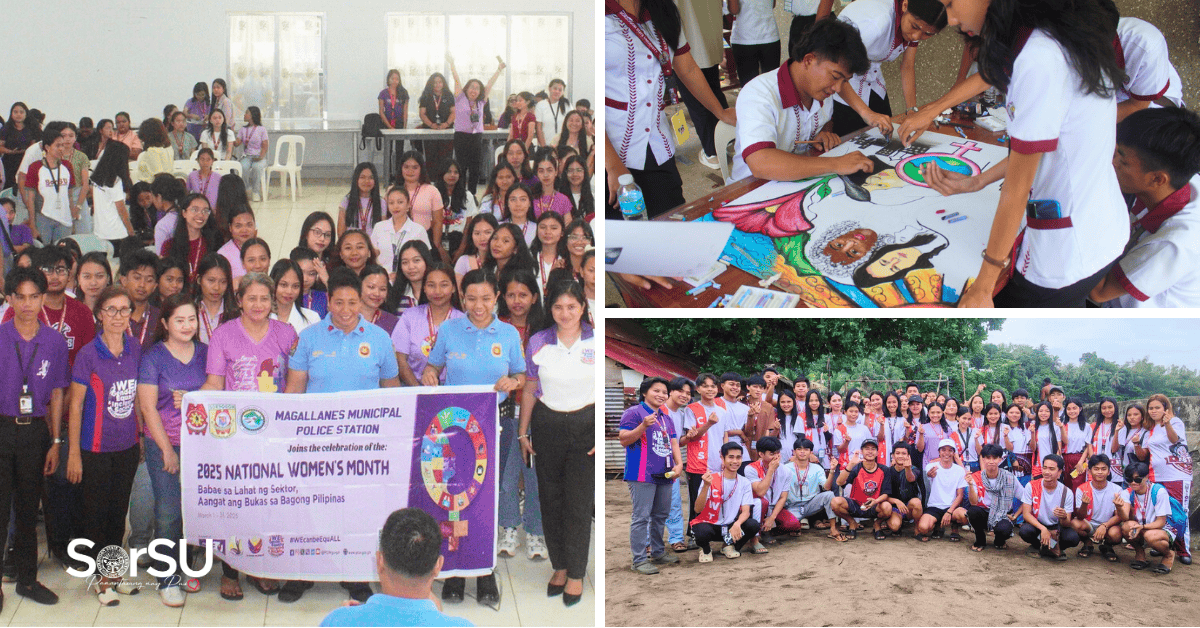
As the university concludes its celebration of Women’s Month, the final day, March 31, marked the culmination of a series of activities aimed at promoting gender equality and women’s empowerment. In line with this, the university spearheaded two significant initiatives: the distribution of Information, Education, and Communication (IEC) materials on the Magna Carta of Women and the lighting of purple lights in university buildings and landmarks.
Highlights
DATA 2023-2024
Research on Gender Equality
Exploring Clinical Practice Education for Student Midwives: Hospital and Community Opportunities and Challenges (Focus on a female-dominated health profession)
DATA 2022-2023
Challenges and Coping Mechanisms of Young Mothers in the Municipality of Bulan
The Plight of Sorsogon City Women during the Covid 19 Pandemic
Sports Inequality: The LGBTQA Intercollegiate Athletes Experience in Selected Higher Education Institutions in the Philippines
Motivation and Challenges in a Humble Beginning: The Case of Young Potential Filipino (Batang Pinoy) Boxers
DATA 2023-2024
Proportion of first-generation female students
Proportion of first-generation female students
Proportion of women first-generation
5.2.1 Number of women starting a degree: 2,706
– Number of Women Starting a Degree-1st Sem AY 2023-2024
– Number of Women Starting a Degree-2nd Sem AY 2023-2024
5.2.2 Number of first-generation women starting a degree: 453
– Proportion of First-Generation Female Students Year 2023
5.2.3 Number of Students starting a degree – 5,170
– Students Starting a Degree Link 1
5.2.4 Number of first-generation students starting a degree – 728
– Proportion of First-Generation Female Students Year 2023
5.2.5 Number of students – 17,165
DATA 2022-2023
Proportion of first-generation female students
Number of women starting a degree: 2,656
Number of first-generation women starting a degree: 636
Proportion of women first-generation: 25.6%
DATA 2023-2024
Tracking access measures | Link 1 |
– Reiteration of Policy on Students Admission Pursuant to the BOR – Approved Academic Manual
– Students Handbook – Admission Policies (Page 5)
Policy for women applications and entry | Link 1 |
– Reiteration of Policy on Students Admission Pursuant to the BOR – Approved Academic Manual
Women’s access schemes
Mentoring
Scholarship
– 5.3.3 Scholarships – Learning Development Program
– List of Students Receiving Scholarship
– List of Female Employees with Scholarship
– Student access measures (Scholarship Women)
Other provision
– Reiteration of Policy on Students Admission Pursuant to the BOR – Approved Academic Manual
DATA 2022-2023
Student access measures
Tracking access measures
– Systems used by SorSU
– Summary of Enrollees (1st Sem. A.Y. 2022-2023) (2nd Sem. A.Y. 2022-2023)(1st Sem. A.Y. 2023-2024) (2nd Sem. A.Y. 2023-2024)
– Summary of Applicants (Contact ssc@sorsu.edu.ph for more information)
Policy for women applications and entry
Women’s access schemes
– Mentoring
– Scholarship (Female Students Receiving Scholarship) (Female Employees with Scholarship)
– Other provision
DATA 2023-2024
Women’s application in underrepresented subjects | Link 1 |
Encourage applications by women in subjects where they are underrepresented.
– 5.3.4 Women’s application in underrepresented subjects– Reiteration of Policy on Students Admission Pursuant to the BOR – Approved Academic Manual
DATA 2022-2023
Women’s application in underrepresented subjects
– through university outreach
– through collaboration
DATA 2023-2024
Proportion of senior female academics
Proportion of senior female academics: 63 females and 64 male
Number of senior academic staff: 127
Number of female senior academic staff: 63
Proportion of women receiving degrees
Proportion of female degrees awarded: 1,474
Number of graduates: 2,532
Number of graduates by subject area (STEM, Medicine, Arts & Humanities / Social Sciences): 2,373
Number of graduates – STEM: 1,376
Number of graduates – Medicine: 202
Number of graduates – Arts & Humanities / Social Sciences: 795
Number of female graduates by subject area (STEM, Medicine, Arts & Humanities / Social Sciences): Total: 1,474
Number of female graduates – STEM: 663
Number of female graduates – Medicine: 191
Number of female graduates – Arts & Humanities / Social Sciences: 620
DATA 2022-2023
Proportion of senior female academics
Number of senior academic staff
Number of female senior academic staff
Number of employees
Proportion of women receiving degrees
Number of graduates: 2,933
Number of graduates by subject area (STEM, Medicine, Arts & Humanities / Social Sciences): 2,933
STEM: 1,822
Medicine: 116
Arts & Humanities/Social Sciences: 995
Number of female graduates by subject area (STEM, Medicine, Arts & Humanities/Social Sciences): 1,805
STEM: 1,009
Medicine: 104
Arts & Humanities/Social Sciences: 692
DATA 2023-2024
Women’s progress measures
Policy of non-discrimination against women
Non-discrimination policies for transgender
– Policy of non-discrimination against women
– Reiteration of Policy on Students Admission Pursuant to the BOR – Approved Academic Manual
Maternity policy
Childcare facilities for students
– Pink Room – Lactation Break Room (Page 19)
– Child Minding Center Proposal (Page 25)
– CHED-UNIFAST MC No. 02, s. 2023 – Standardized Guidelines on the Implementation of the Tulong Dunong Program for State Universities and Colleges for the First Semester of Acadmeic Year 2023-2024
– CHED-UNIFAST MC No. 05, s. 2023 – Tertiary Education Subsidy (TES) Slots for Fiscal Year 2023
Childcare facilities for staff and faculty
– Pink Room – Lactation Break Room (Page 19)
– Child Minding Center Proposal (Page 25)
Women’s mentoring schemes
Track women’s graduation rate
Policies protecting those reporting discrimination
Paternity policy
DATA 2022-2023
Women’s progress measures
Policy of non-discrimination against women
Non-discrimination policies for transgender
Maternity Policy
Childcare facilities for students
Childcare facilities for staff and faculty
Women’s mentoring schemes
Track women’s graduation rate | SIAS
Policies protecting those reporting discrimination
Paternity Policy